
Donkey Secondary Antibodies


Medchemexpress LLC HRP-conjugated Donkey Anti-Rabbit IgG H&L | 100 UL

HRP-conjugated Donkey Anti-Rabbit IgG H&L is a HRP-conjugated and Donkey origined Polyclonal antibody, targeting to Rabbit IgG. Donkey Anti-Rabbit IgG H&L(HRP) can binds to the light and heavy chains of Rabbit IgG antibodies.
- WB (Western Blot): 1:5000 - 1:20000
- IHC-P (Immunohistochemistry-Paraffin): 1:500 - 1:1000
- ICC/IF (Immunocytochemistry/Immunofluorescence): 1:500 - 1:1000
- ELISA (Enzyme Linked Immunosorbent Assay): 1:5000 - 1:20000


Biotium Secondary Antibody Rabbit IgG Donkey CF505 1/EA
This product is prepared by labeling highly cross-adsorbed donkey anti-rabbit IgG (H plus L) with CF and reg 505 dye CF and reg dyes are Biotiums line of next-generation fluorescent dyes with advantages in brightness photostability and conjugate specificity compared to other fluorescent dyes Red fluorescent CF and reg 505 dye has excitation/emission at 505/519 nm To minimize cross-reactivity the antibody has been adsorbed against bovine chicken goat guinea pig Syrian hamster horse human mouse rat and sheep serum Single label antibodies have an average of one dye molecule per antibody molecule which is reported to be optimal for super-resolution imaging by STORM

Electron Microscopy Sciences Aurion ImmunoGold Donkey-anti-Rabbit IgG (H&L), EM-grade 15nm 1.4 ML
It is impossible to perform a double labeling experiment in combination with, for instance a mouse primary antibody, since applicable secondary antibodies are either raised in rabbit or goat. To overcome this difficulty the Aurion Series of Secondary ImmunoGold conjugates is based on antibodies raised in Donkey, including Donkey-anti-Goat. It is then known that mixing Donkey-anti-Goat and Donkey-anti-Mouse provides a successful solution.
Particle size: EM-grade 15nm
Cayman Chemical ThIordoxIn 2 RabIt MoncLN 50uL
A peptide orexin receptor 1 agonist selectively induces calcium mobilization in CHO cells overexpressing human OX1R over CHO cells overexpressing human OX2R (EC50s 8.29 and 187 nM respectively)
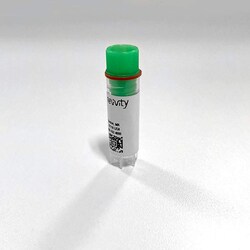
Revvity Health Sciences Inc Membrane Target Systems: Serotonin 5HT6 (rat) membrane preparation
Membrane Target Systems: Serotonin 5HT6 (rat) membrane preparation


Jackson Immuno Research Labs Brilliant Violet™ 480-AffiniPure Donkey Anti-Rabbit IgG (H+L) (min X Bov Ck Gt GP Sy Hms Hrs Hu Ms Rat Shp Sr Prot)
Brilliant Violet™ 480-AffiniPure Donkey Anti-Rabbit IgG (H+L) (min X Bov Ck Gt GP Sy Hms Hrs Hu Ms Rat Shp Sr Prot)
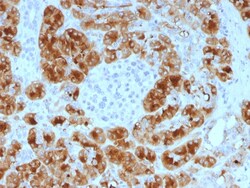
Biotium GP2 (Glycoprotein 2) / ZAP75 (GP2/1805), CF647 conjugate, 0.1mg/mL
GP2 (glycoprotein 2), also known as ZAP75, is a 537 amino acid secreted protein. It is an integral membrane protein that is secreted from intracellular zymogen granules and associates with the plasma membrane via glycosylphosphatidylinositol (GPI) linkage. GP2 is cleaved and then released into the pancreatic duct along with exocrine secretions. GP2 binds pathogens such as enterobacteria, thereby playing an important role in the innate immune response. The C-terminus of this protein is related to the C-terminus of the protein encoded by the neighboring gene, uromodulin (UMOD). GP2 is also expressed on the apical plasma membrane of specialized microfold (M) cells among enterocytes and serves as a transcytotic receptor for mucosal antigens. M cells are considered a promising target for oral vaccination against various infectious diseases.Primary antibodies are available purified, or with a selection of fluorescent CF Dyes and other labels. CF Dyes offer exceptional brightness
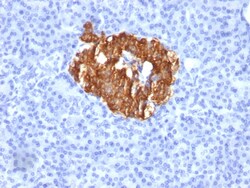
Biotium Insulin / IRDN (beta-Cell & Insulinoma Marker)(K36aC10), CF647 conjugate, 0.1mg/mL
Recognizes a polypeptide which is identified as insulin, a 51-amino acid polypeptide composed of A and B chains connected through the C-peptide. Proinsulin, which has very little biological activity, is cleaved by proteases within its cell of origin into the insulin molecule and the C-terminal basic residue. Insulin enhances membrane transport of glucose, amino acids, and certain ions. It also promotes glycogen storage, formation of triglycerides, and synthesis of proteins and nucleic acids. Deficiency of insulin results in diabetes mellitus. The main storage site for insulin is the pancreatic islets. Antibodies to insulin are important as beta-cell and insulinoma marker. Primary antibodies are available purified, or with a selection of fluorescent CF Dyes and other labels. CF Dyes offer exceptional brightness and photostability. Note: Conjugates of blue fluorescent dyes like CF405S and CF405M are not recommended for detecting low abundance targets, because blue dyes hav
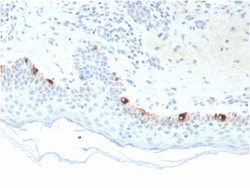
Biotium Tyrosinase-Related Protein-1 (TYRP-1) (Melanoma Marker)(TYRP1/3281), CF647 conjugate, 0.1mg/mL
Reacts with a 75 kDa melanocyte-specific gene product, identified as Tyrosinase-related protein-1 (TRP-1). It is involved in melanin synthesis. TRP1 is present on the melanosomal membranes of melanoma, normal melanocytes and nevi. Recent evidence suggests that TRP-1 is involved in maintaining stability of tyrosinase protein and modulating its catalytic activity. TRP-1 is also involved in maintenance of melanosome ultrastructure and affects melanocyte proliferation and cell death. Primary antibodies are available purified, or with a selection of fluorescent CF Dyes and other labels. CF Dyes offer exceptional brightness and photostability. Note: Conjugates of blue fluorescent dyes like CF405S and CF405M are not recommended for detecting low abundance targets, because blue dyes have lower fluorescence and can give higher non-specific background than other dye colors.

Biotium Secondary Antibody Mouse IgG Donkey CF505 1/EA
This product is prepared by labeling highly cross-adsorbed donkey anti-mouse IgG (H plus L) with CF and reg 505 dye CF and reg dyes are Biotiums line of next-generation fluorescent dyes with advantages in brightness photostability and conjugate specificity compared to other fluorescent dyes Red fluorescent CF and reg 505 dye has excitation/emission at 505/519 nm To minimize cross-reactivity the antibody has been adsorbed against bovine chicken goat guinea pig Syrian hamster horse human rabbit and sheep serum Single label antibodies have an average of one dye molecule per antibody molecule which is reported to be optimal for super-resolution imaging by STORM
Sino Biological Protein HTNV-GP Biotin 20UG
A DNA sequence encoding the Hantaan virus (strain 76-118) Envelopment polyprotein/GP (P08668) (Ser649-Asn1105) was expressed with a C-terminal polyhistidine tag followed by an AVI tag The expressed protein was biotinylated in vivo by the Biotin-Protein ligase (BirA enzyme) which is co-expressed
Biotium CD45RO(UCHL-1), CF647 conjugate, 0.1mg/mL
Recognizes a 180-185 kDa protein, identified as isoform of leukocyte common antigen (CD45RO) (4th Leucocyte Typing Workshop: Code No. N31). The epitope recognized by this antibody is sensitive to neuraminidase digestion. This antibody reacts with mature activated T-cells, most thymocytes, and a sub-population of resting T-cells within both CD4 and CD8 subsets. It shows no reactivity with normal B or natural killer cells, but reacts with granulocytes and monocytes. Reportedly, it is useful to identify T-cell lymphomas and leukemias. It rarely stains NK cells or B-cell lymphomas.Primary antibodies are available purified, or with a selection of fluorescent CF Dyes and other labels. CF Dyes offer exceptional brightness and photostability. Note: Conjugates of blue fluorescent dyes like CF405S and CF405M are not recommended for detecting low abundance targets, because blue dyes have lower fluorescence and can give higher non-specific background than other dye colors.
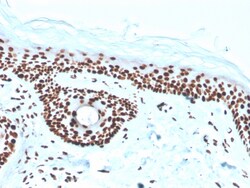
Biotium Nucleophosmin (Acute Myeloid Leukemia Marker)(rNPM1/1901), CF647 conjugate, 0.1mg/mL
Recognizes a 33 kDa glycoprotein, identified as Nucleophosmin (NPM). It is predominantly localized in the nucleus of cells in most tissues. NPM is involved in ribosomal assembly and rRNA transport. It is an abundant protein that is highly phosphorylated by Cdc2 kinase during mitosis. This phosphoprotein moves between the nucleus and the cytoplasm. It is thought to be involved in several processes including regulation of the ARF/p53 pathway. A number of genes are fusion partners, in particular the anaplastic lymphoma kinase gene on chromosome 2. Mutations in exon 12 affecting the C-terminus of the protein are associated with an aberrant cytoplasmic location. Mutations in this gene are associated with acute myeloid leukemia. The antibody may be a useful aid for classification of acute myeloid leukemia. Primary antibodies are available purified, or with a selection of fluorescent CF Dyes and other labels. CF Dyes offer exceptional brightness and photostability. Note: Conjugat
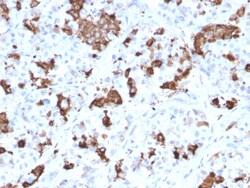
Biotium Prolactin (Pituitary Tumor Marker)(PRL/2644), CF647 conjugate, 0.1mg/mL
Prolactin is a growth factor that is secreted by the anterior pituitary. It is necessary for the proliferation and differentiation of the mammary glands. Prolactin is useful in the classification of pituitary tumors and study of pituitary disease. It also plays a role in the development of mammary cancer, functioning dually as a mitogen and a differentiating agent. Primary antibodies are available purified, or with a selection of fluorescent CF Dyes and other labels. CF Dyes offer exceptional brightness and photostability. Note: Conjugates of blue fluorescent dyes like CF405S and CF405M are not recommended for detecting low abundance targets, because blue dyes have lower fluorescence and can give higher non-specific background than other dye colors.
Biotium Tyrosinase(T311), CF647 conjugate, 0.1mg/mL
Recognizes a cluster of proteins between 70-80 kDa, identified as tyrosinase. Occasionally a minor band at 55 kDa is also detected. This MAb shows no cross-reaction with MAGE-1 and tyrosinase-related protein 1, TRP-1/gp75. Tyrosinase is a copper-containing metalloglycoprotein that catalyzes several steps in the melanin pigment biosynthetic pathway; the hydroxylation of tyrosine to L-3,4-dihydroxy-phenylalanine (dopa), and the subsequent oxidation of dopa to dopaquinone. Mutations of the tyrosinase gene occur in various forms of albinism. Tyrosinase is one of the targets for cytotoxic T-cell recognition in melanoma patients. Staining of melanomas with this MAb shows tyrosinase in melanotic as well as amelanotic variants. This MAb is a useful marker for melanocytes and melanomas.Primary antibodies are available purified, or with a selection of fluorescent CF Dyes and other labels. CF Dyes offer exceptional brightness and photostability. Note: Conjugates of blue fluorescent d